Grid connection
Power/PV — controllable load, grid draw toward zero. Part of the glass family — like our glass BESS, biogas plant and CHP.
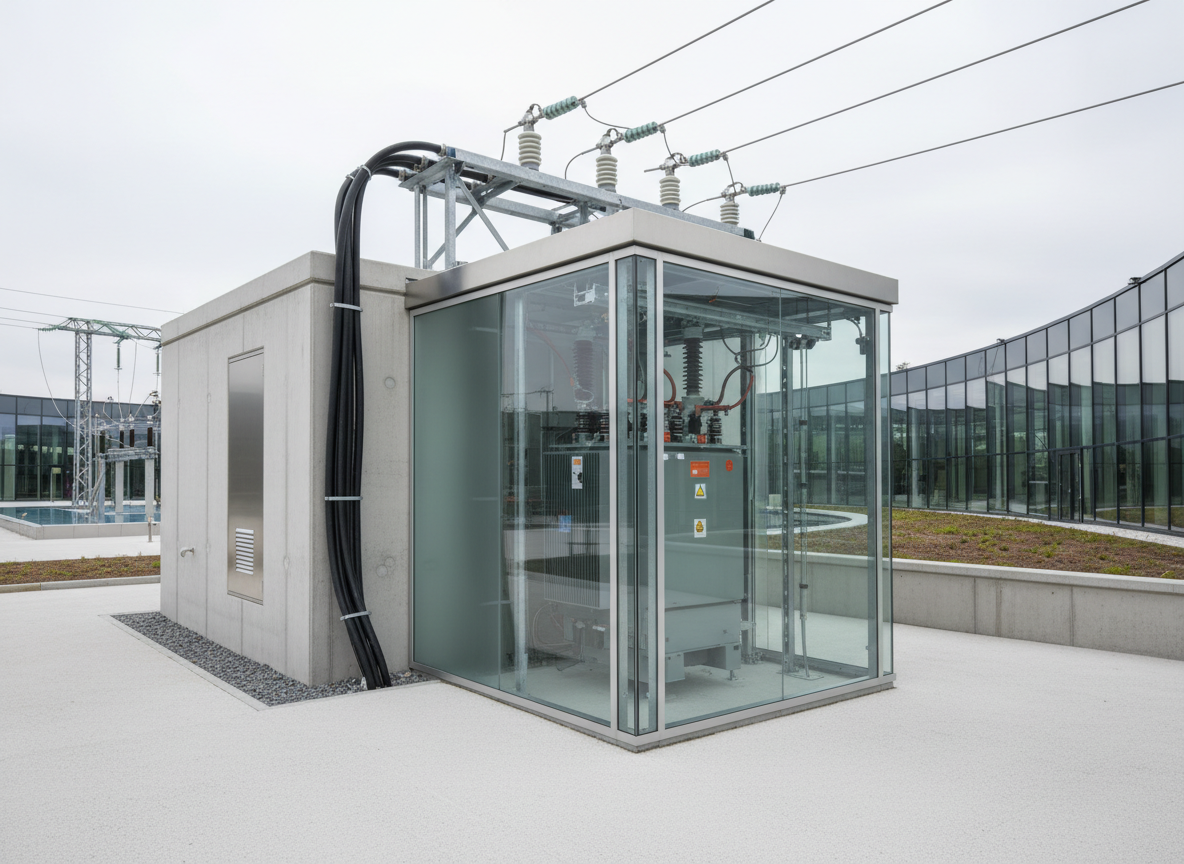
PV → LV distribution → AI controller → Pool load → Grid → BESS
Power/PV — controllable load, grid draw toward zero. Part of the glass family — like our glass BESS, biogas plant and CHP.
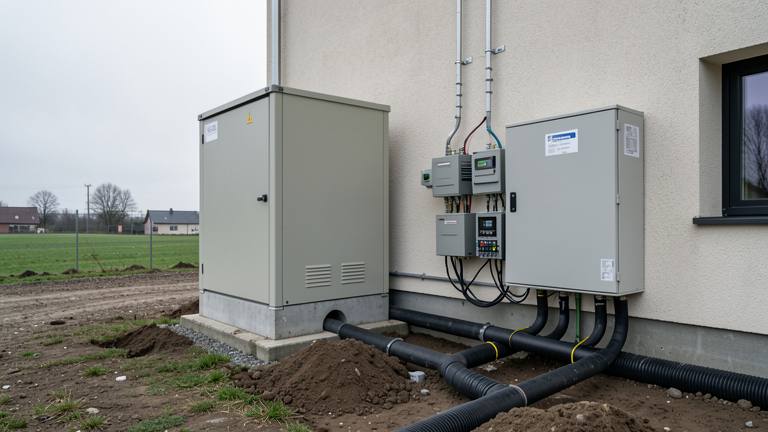
The grid connection is the buffer that balances whatever PV and storage do not currently cover. Import and export kWh are metered register-true at the main meter.
The AI targets near-zero grid draw in PV hours and shaves load peaks — every avoided peak lowers the demand charge.
PV as controllable load, LV distribution, grid as buffer:
Overview: The Glass Pool → · Markets: pool markets →
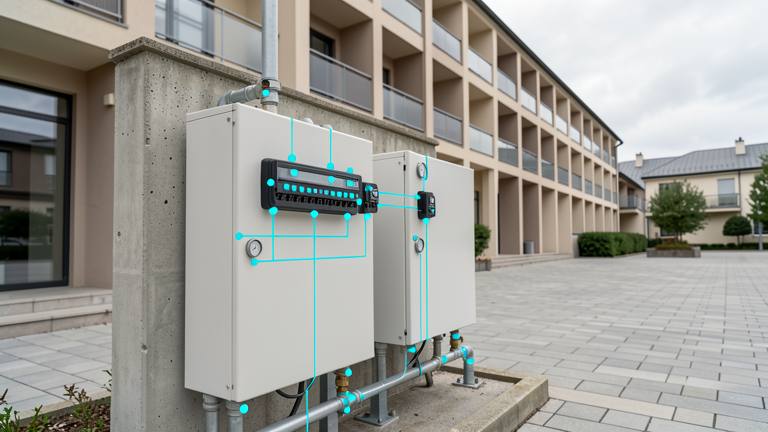
Monitored: continuously · import, export and peak
The scenario: A single quarter-hour sets the demand charge for the whole month. Nothing fails when it happens — the peak is simply recorded, and paid for twelve times over.
Method proven on a live European reference aquatic center; presented anonymously.
Estimate from metered / design values. Zero-grid-import windows are real (metered).
Grounded in the applicable national standards for pool water treatment, plant energy performance and building energy performance. Same knowledge base as the European reference site; presented anonymously.
The applicable standard governs the connection of generation systems to the low-voltage grid. Systems above 30 kVA must participate in the grid-operator control scheme — the operator may curtail feed-in when the grid is critically loaded. A pool with 643 kWp is well above this threshold. The local low-voltage cluster score is 7/10, so the probability of curtailment is low but technically possible. Load management lowers this risk because less power is fed in.
Basis: the applicable national standard
The market master-data registry requires all PV and storage systems above 800 W to be registered within one month of commissioning. An existing 243 kWp roof PV is registered; a new 400 kWp car-port PV must be registered at commissioning. Registration is a precondition for feed-in tariffs, and the registry entry is often required as proof for grant funding.
Basis: Grid registry (BNetzA MaStR)
Stationary battery storage (BESS) in a public pool is currently not economical at sites without redispatch stress and with a low day-ahead spread. Typical site: redispatch score 0/10 (no curtailment), grid-control score 7/10 (little curtailment leverage). Day-ahead spread ~150 €/MWh — too little for BESS arbitrage. Re-evaluate in 2028/29 if the spread exceeds 200 €/MWh or a grant co-funds storage. For now, load management (synchronising HP/ventilation/filters to PV) with a payback below 1 year is the far better investment.
Basis: Practice + site analysis
Load-management systems switch shiftable loads in sync with PV production. In a pool the ideal moves are: modulate the heat pumps onto the PV profile, raise ventilation stages when PV surplus exists, run the main filter pumps during the day, dim lighting during daylight. Investment 30-60 k€ depending on the number of switching devices and building-management integration. Self-consumption ratio typically rises from 30 % to 55-70 % with broad integration. Precondition: all main loads are Modbus/MQTT-capable.
Basis: Practice (e3dc, ESL, Solarwatt)
Pools have a daytime load profile that fits PV well: pumps run during opening hours (typically 9 a.m.-9 p.m.), ventilation ramps up in day operation, heat-pump heat-up can be time-shifted. Without load management the self-consumption ratio is 30-40 %. With load management (all main loads controlled): 60-75 %. Adding BESS: 80-90 % is possible but only economic at high day-ahead spreads. Example potential: 643 kWp × 815 kWh/kWp/a = 524 MWh/a; at 60 % self-consumption = 314 MWh/a × (0.25 − 0.06) €/kWh = 60 k€/a of extra saving from load management.
Basis: Practice studies
Stromfee.US licenses the pool & wellness HVAC AI — proven in Europe, deployed on your existing plant. Single property, portfolio or chain.
Request software license →