Standards & norms What the rules require — Circulation (indoor)
Grounded in the applicable national standards for pool water treatment, plant energy performance and building energy performance. Same knowledge base as the European reference site; presented anonymously.
What do the applicable standards require regarding Filtration and circulation?
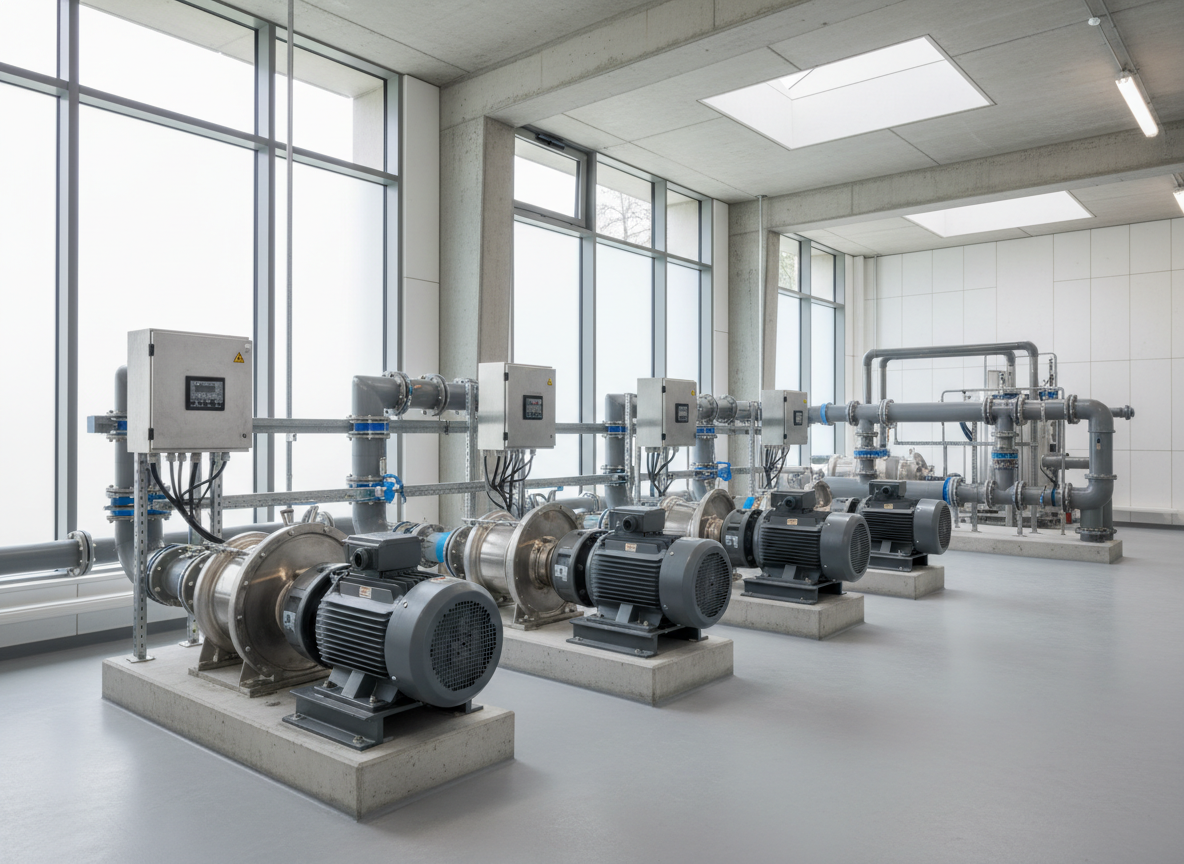
The applicable standard prescribes a maximum residence time of the pool water, depending on pool type: swimmer pools 4 h turnover, non-swimmer/paddling 1-2 h. This sets the minimum filter flow rate. For a 242 m³ lap pool at 4 h turnover that is 60.5 m³/h of filter capacity. Filter backwash once per day or above 0.5 bar differential pressure. Backwash water is warm (pool temperature − 3-5 K) and therefore a valuable heat-pump source.
Basis: the applicable national standard
What do the applicable standards require regarding Minimum fresh-water make-up?
The applicable standard requires a minimum fresh-water make-up of 30 litres per visitor per day, independent of filter performance. This make-up dilutes metabolic products, urea and other substances introduced by bathers. At 1,500 visitors/week × 52 weeks that is 2,340 m³/a, which has to be heated from drinking-water temperature (~10 °C) to pool set-point (22-32 °C). At a 28 °C pool set-point this is roughly 50 MWh/a of heating energy for fresh water alone.
Basis: the applicable national standard
What do the applicable standards require regarding Water-treatment process combinations?
Standard process combination for public pools: multi-layer sand filter + flocculation + chlorine-dioxide or chlorine-gas disinfection. Alternatives use activated carbon (treatment) or UV (disinfection). Sand-filter layering: fine sand 0.4-0.6 mm on top, gravel support layer below. Filter velocity max 30 m/h. Backwash at 50-60 m/h up-flow for 5-10 min, backwash volume approx. 5× the filter-bed volume.
Basis: the applicable national standard
What do the applicable standards require regarding Pool evaporation balance?
Evaporation from the water surface is the dominant heat loss in an indoor pool (60-80 %). Smith/Löf variant of the Carrier formula: m_evap [kg/h] = β × A [m²] × (p_w_pool − p_w_hall) [kPa]. β-coefficient per the pool energy guideline (evaporation and ventilation) Tab. 4: 0.013 unused pool (covered), 0.040 normal use, 0.080 wave/diving pool. Evaporation enthalpy at 30 °C: 0.694 kWh/kg. Pool saturation vapour pressure via the Magnus formula: 611.2 × exp(17.62 × t / (243.12 + t)) Pa.
Basis: the applicable national standard
What do the applicable standards require regarding Outdoor-pool convection and radiation?
Outdoor pools have higher convection and radiation losses. Convection: h_conv = 4 + 11 × v_wind [W/(m²·K)] with v in m/s. At 1 m/s wind: h ≈ 15 W/(m²·K). Night radiation (clear sky): ~60 W/m² over a 10 h night. Solar gain during the day (global radiation × absorptivity 0.82 × 12 h) is a credit — in high summer it can drop the heat demand close to zero. A night cover reduces both evaporation (−85 %) and radiation loss (−90 %).
Basis: the applicable national standard