Air handling (total)
Ventilation/dehumidification — the silent 24/7 load, with heat recovery. Part of the glass family — like our glass BESS, biogas plant and CHP.
Outdoor air → Fresh air → Heat recovery → Heating coil → Hall → Exhaust
Ventilation/dehumidification — the silent 24/7 load, with heat recovery. Part of the glass family — like our glass BESS, biogas plant and CHP.
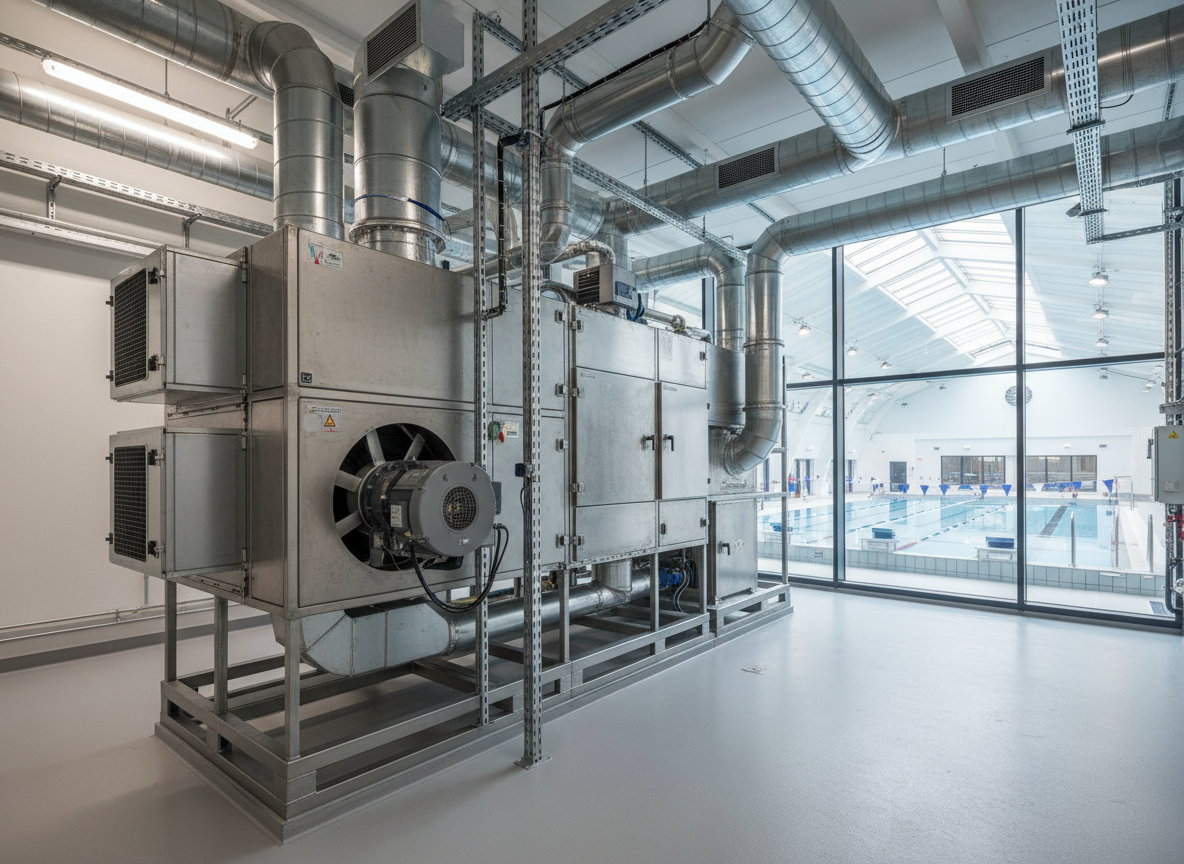
The full air-handling system unites outdoor, supply, exhaust and discharge air, heat recovery and the heating coil into one controlled unit — about 36,000 m³/h at the reference site. It holds the hall climate (30 °C / 55 % RH) and is, together with dehumidification, the biggest heat consumer of the facility.
Traditionally these parts run side by side on fixed setpoints. Treated as one system, the big levers appear only in their interplay: minimum air change, maximum recovery, reheating only as the remainder.
Dehumidification with heat recovery (the ventilation standard for indoor pools, 36,000 m3/h):
Overview: The Glass Pool → · Markets: pool markets →
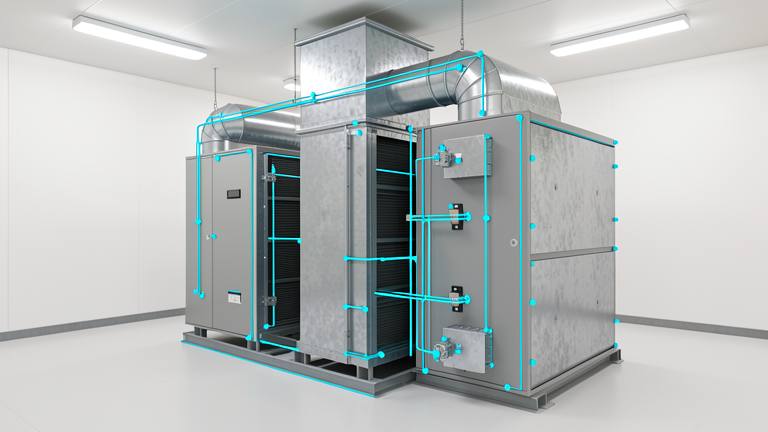
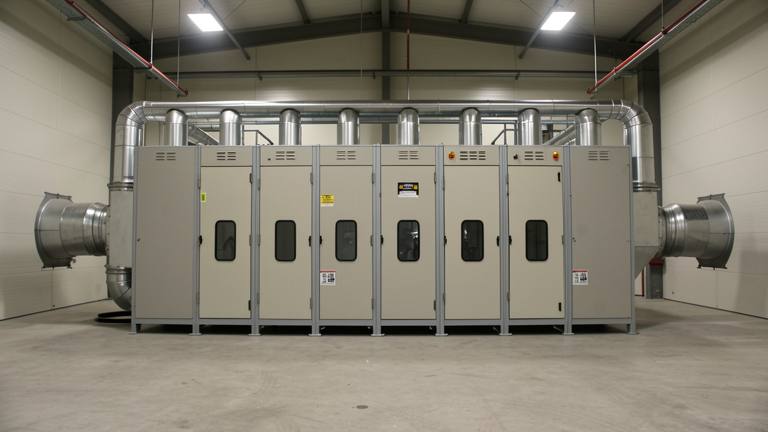
Monitored: continuously · the whole air path, section by section
The scenario: Every section passes its own check. Only across the complete path does it show that supply and extract no longer balance — the sum is wrong although each part is right.
Method proven on a live European reference aquatic center; presented anonymously.
Estimate from metered / design values. Zero-grid-import windows are real (metered).
Grounded in the applicable national standards for pool water treatment, plant energy performance and building energy performance. Same knowledge base as the European reference site; presented anonymously.
The applicable standard defines the target hall climate: air temperature 30 °C ± 2 K, relative humidity 55 % ± 5 %. Outdoor-air rate at least 30 m³/h per person at full occupancy, at least 4 L/(s·m² of water surface) in base mode. For a hall with 355 m² water surface: 4 × 355 × 3.6 = 5,112 m³/h minimum; in practice The applicable standard recommends ~16,000 m³/h for comfort and pollutant removal (trihalomethanes). Heat recovery via plate exchanger at 65-75 % efficiency is standard.
Basis: the applicable national standard
When hall humidity is too high (rH > 65 %) the traditional fix is raising the outdoor-air rate — which doubles the heat loss in winter. The modern approach is a dehumidifying heat pump (sorption wheel or reversible compressor) that removes water directly from the hall air without raising outdoor air. Investment 30-80 k€ depending on size, payback 4-7 years. On a hall running 16,000 m³/h in cold winters a sorption wheel can save 30-50 % of the ventilation heating energy.
Basis: the applicable national standard
Evaporation from the water surface is the dominant heat loss in an indoor pool (60-80 %). Smith/Löf variant of the Carrier formula: m_evap [kg/h] = β × A [m²] × (p_w_pool − p_w_hall) [kPa]. β-coefficient per the pool energy guideline (evaporation and ventilation) Tab. 4: 0.013 unused pool (covered), 0.040 normal use, 0.080 wave/diving pool. Evaporation enthalpy at 30 °C: 0.694 kWh/kg. Pool saturation vapour pressure via the Magnus formula: 611.2 × exp(17.62 × t / (243.12 + t)) Pa.
Basis: the applicable national standard
the pool operating guideline fixes the order for refurbishments: 1) reduce losses (envelope, pool cover, insulate the surge tank, ventilation heat recovery), 2) recover heat (heat recovery, waste-water heat, filter backwash as a heat-pump source), 3) generate efficiently (heat pump > CHP > gas). This hierarchy is decisive for public grant applications: funders check whether losses were reduced before the generation investment. Concretely: insulate the surge tank, add an outdoor-pool night cover and service the ventilation heat recovery before or together with the heat-pump installation.
Basis: the applicable national standard.10
The applicable standard governs ventilation with hygiene requirements. For pool halls: filter class F7 minimum, 6-month service interval. Plate heat-recovery exchangers must be able to drain condensate. Hygiene inspection every 2 years (logged in the maintenance record). Pool-specific: because of chloramines, corrosion-resistant materials (V4A stainless, plastic) are required in the exhaust stream; aluminium exchangers are not permitted in the pool-hall exhaust air.
Basis: the applicable national standard
Stromfee.US licenses the pool & wellness HVAC AI — proven in Europe, deployed on your existing plant. Single property, portfolio or chain.
Request software license →