Heat pump 3
Heat generation — modulating cascade, real seasonal COP 4-7. Part of the glass family — like our glass BESS, biogas plant and CHP.
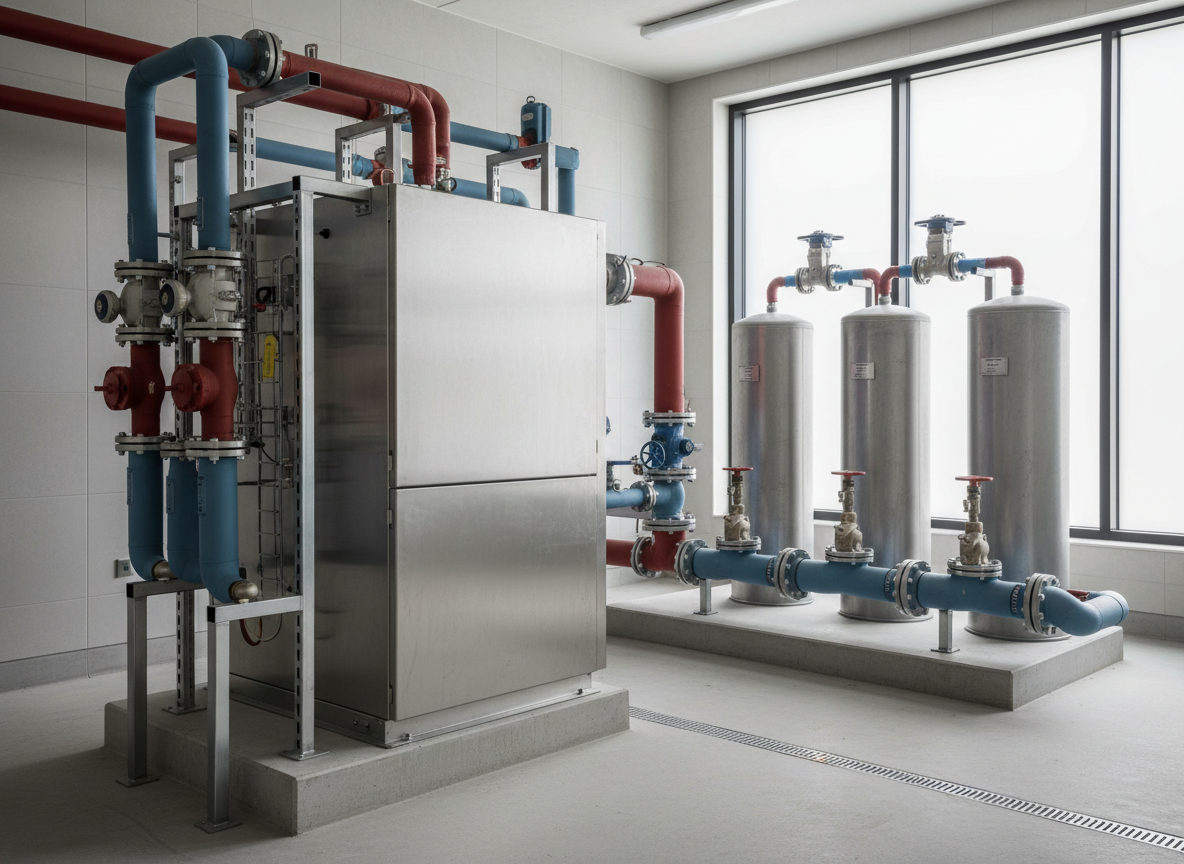
Heat source → HP cascade → Buffer store → Consumers
Heat generation — modulating cascade, real seasonal COP 4-7. Part of the glass family — like our glass BESS, biogas plant and CHP.
Heat pump 3 is the third stage, switched in at high load — for example during the spring outdoor-pool heat-up or on cold winter days with high ventilation heat demand.
The AI stages by load and source: first the HP on the warmest source, then the next — keeping the cascade COP as high as possible across all stages.
Modulating heat pump(s), cascade 4x100 kW, buffer (stratified):
Overview: The Glass Pool → · Markets: pool markets →
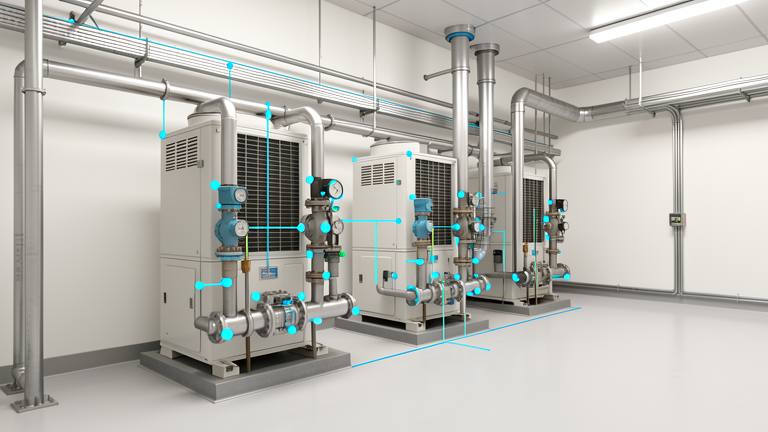
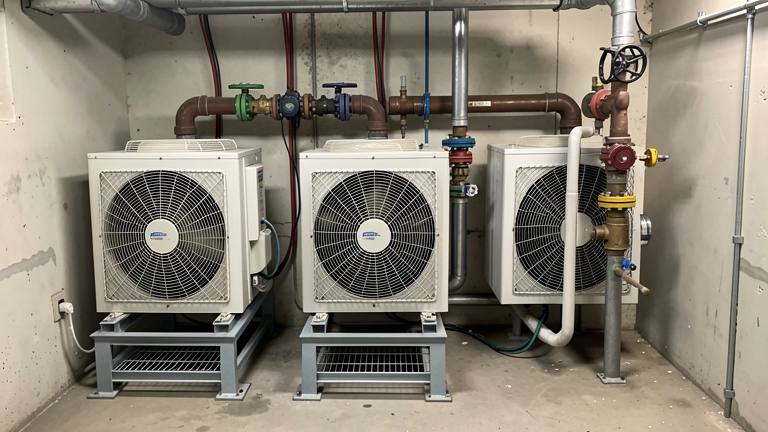
Monitored: continuously · share of the common load
The scenario: A unit in the middle of the header takes more than its share because the hydraulics favour it. It ages faster than its twins while every reading stays inside limits.
Method proven on a live European reference aquatic center; presented anonymously.
Estimate from metered / design values. Zero-grid-import windows are real (metered).
Grounded in the applicable national standards for pool water treatment, plant energy performance and building energy performance. Same knowledge base as the European reference site; presented anonymously.
Modern inverter pool air-to-water heat pumps reach rated-point COPs (source 26 °C, sink 27 °C) between 14 and 18 (e.g. AquaForte InverterPro 16.5, Microwell HP1500 Split 17, Pontaqua Inverter+ 14). These are data-sheet values at the thermodynamically most favourable operating point. The seasonal COP (SCOP) — accounting for heat-up phases, cooler sources and standstill losses — sits at 8-12. Inverter pool HPs typically modulate between 30 % and 100 % of rated output; some industrial models (Carrier 30RB, Stiebel WPL) down to 25 %. The source must be > 5 °C for the evaporator to work without icing.
Basis: Manufacturer data sheets (AquaForte, Microwell, Pontaqua)
The applicable standard defines the seasonal coefficient of performance (SCOP) averaged across the year. Crucially it includes heat-up phases, standstill losses and auxiliary loads (pumps, controls). A realistic SCOP for an inverter pool air-water HP on a warm source is 8-12 (versus a rated-point COP of 14-18). Factors that depress SCOP: a cold source in winter (outdoor air), a high sink (pool heat-up) and frequent cycling (oversizing). For grant applications a conservative SCOP of 8 is advisable — even where a model computes 11.3, that is a best-case assumption.
Basis: the heat-pump performance guideline-1 + the national pool-operators association
For pools with strongly varying heat load (outdoor heat-up in April, near-zero summer, hall pool year-round) a cascade of several modulating pool heat pumps beats one large unit. A 500 kW industrial air-water HP with inverter min 30-40 % covers a 175-500 kW window. A cascade of 4 × 125 kW pool HPs covers 37-500 kW (8 % min) via stepped switching — far closer to the actual load profile. Benefits: redundancy (loss of one HP is 25 % of capacity, not 100 %), better modulation onto the PV profile, less cycling in low summer load.
Basis: the heat-pump performance guideline / the pool operating guideline
Filter backwash water is the most valuable heat source for pool heat pumps. Temperature: pool set-point minus 3-5 K (26 °C for a hall pool, 19 °C outdoor). Volume: typically 1× the filter-bed volume per day, approx. 5-10 m³ per filter. Energy content: with a 60 m² backwash tank surface at 25 °C water this yields 290 kWh/d of usable heat on the HP evaporator side. Connection: a heat exchanger between backwash water and the HP brine loop keeps the evaporator clean. Investment: ~10 k€ for the exchanger + controls.
Basis: the applicable national standard.10 + manufacturer data
CHP units were standard in pools in the 2010s but are usually economically inferior to heat-pump concepts today. CHP advantage: constant base heat load (a hall pool is ideal) and self-generated power. Disadvantages: high specific heat-generation cost (~7 ct/kWh) versus a heat pump on a warm source (~3 ct/kWh at SCOP 10); no regional grant when paired with federal CHP funding; worse CO₂ balance (natural gas) than the power mix. CHP makes sense only for hot-water hygiene needs above 60 °C or as peak-load back-up. A pool without special hot-water hygiene needs should not prioritise CHP.
Basis: the national pool-operators association + AGFW + practice
Stromfee.US licenses the pool & wellness HVAC AI — proven in Europe, deployed on your existing plant. Single property, portfolio or chain.
Request software license →