The Glass Pool · WARMWASSER

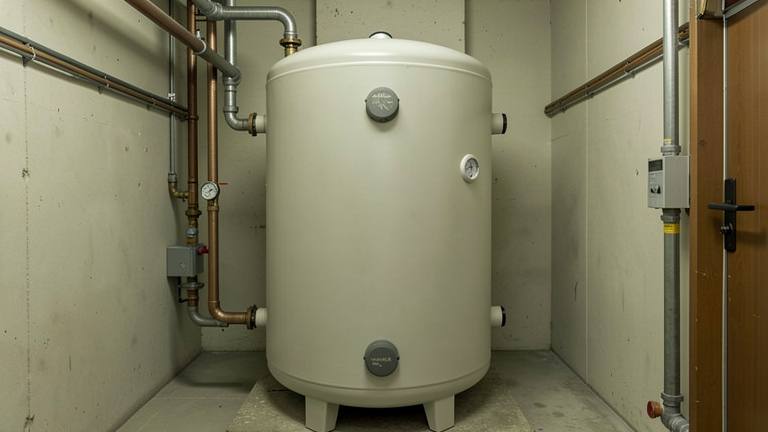
Domestic hot water tank

Hot water — tank, charging and circulation. Part of the glass family — like our glass BESS, biogas plant and CHP.
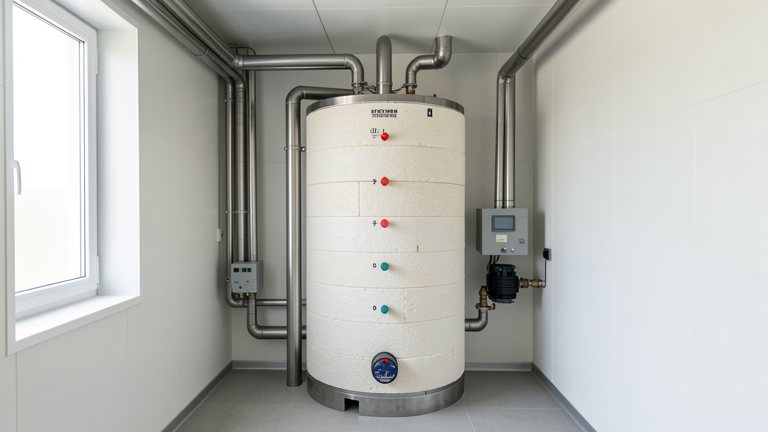
Domestic hot water tank
Generator Charging circuit Stratified tank Draw-off points
Glass-box in 4 steps

Understand → See it live → What the AI does → Your benefit

Step 1 of 4
1
Understand
2
See it live
3
What the AI does
Your benefit

What is Domestic hot water tank?

The stratified tank separates generation from draw-off: hot at the top for consumption, cold at the bottom for recharging. The cleaner the stratification, the more usable volume sits in the same vessel.

Charging runs through a fresh-water station or a heat exchanger. A charging pump set too fast destroys the stratification — the tank turns lukewarm throughout instead of layered, and loses usable capacity.

What is measured here

  • Tank temperature top and bottom — the stratification itself
  • Charging power and charge duration per cycle
  • Draw-off volume via the heat meter
  • Standby loss during hours without draw-off

How we connect it — read-only

  • Tank sensors top and bottom over Modbus or from the building management system.
  • Heat meter in the charging circuit over M-Bus — energy, volume, flow and return.
  • Charging pump through its Modbus interface (speed, power).

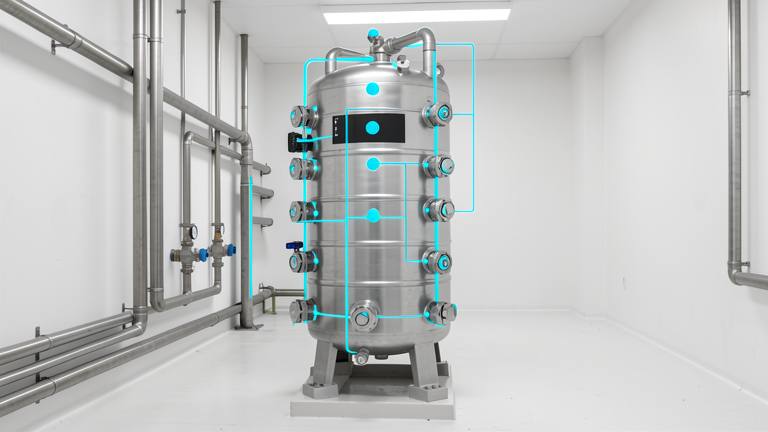
Schematic (native, live)

Hot water — tank, charging and circulation.

GeneratorStratified tankDraw-off points

Overview: The Glass Pool → · Markets: pool markets →
Live —

loading

What the AI does

  • Detects destroyed stratification when top and bottom converge.
  • Places recharging in PV and low-price hours as far as the draw-off forecast allows.
  • Measures the standby loss in draw-off-free nights — the figure reveals insulation quality.
  • Flags a growing charge duration for the same energy — a sign of scaling.
What the AI reads
Scenario

Monitored: continuously · charge state and coil temperatures

The scenario: The cylinder is reheated on a schedule rather than on demand. It stays hot through hours when nothing is drawn, and the standby loss is paid every single night.

Method proven on a live European reference aquatic center; presented anonymously.

Standby loss

Estimate from metered / design values. Zero-grid-import windows are real (metered).

Standards & norms

What the rules require — Domestic hot water tank

Grounded in the applicable national standards for pool water treatment, plant energy performance and building energy performance. Same knowledge base as the European reference site; presented anonymously.

Why does stratification in the tank matter?

Only the hot upper section is immediately usable. If the contents mix, usable capacity falls even though the tank is the same size — and the reheat runs more often.

Basis: plant engineering

How do you spot a scaled heat exchanger?

Charge duration grows for the same transferred energy, and the spread in the charging circuit narrows. Both are measurable long before output visibly collapses.

Basis: plant engineering

How large is the standby loss?

It can only be measured on the actual installation: during a draw-off-free night the tank temperature drops by a specific amount, and the loss follows from that. A blanket figure would be guesswork.

Basis: plant engineering

More pool worlds

Browse the 40 wizards

← PreviousCooking equipment▦ All components
License the software

Bring the glass-box AI to your pool.

Stromfee.US licenses the pool & wellness HVAC AI — proven in Europe, deployed on your existing plant. Single property, portfolio or chain.

Request software license →
{"@context": "https://schema.org", "@type": "FAQPage", "mainEntity": [{"@type": "Question", "name": "Why does stratification in the tank matter?", "acceptedAnswer": {"@type": "Answer", "text": "Only the hot upper section is immediately usable. If the contents mix, usable capacity falls even though the tank is the same size — and the reheat runs more often."}}, {"@type": "Question", "name": "How do you spot a scaled heat exchanger?", "acceptedAnswer": {"@type": "Answer", "text": "Charge duration grows for the same transferred energy, and the spread in the charging circuit narrows. Both are measurable long before output visibly collapses."}}, {"@type": "Question", "name": "How large is the standby loss?", "acceptedAnswer": {"@type": "Answer", "text": "It can only be measured on the actual installation: during a draw-off-free night the tank temperature drops by a specific amount, and the loss follows from that. A blanket figure would be guesswork."}}]}